 The Russian Revolution of 1917 is also called the Bolshevik Revolution or the October Revolution. In 1917 there were actually two revolutions in Russia. One was the February Revolution in which the Tsar abdicated his throne and the Provisional Government took power. The other was the October Revolution in which the Provisional Government was overthrown by the Bolsheviks. Russian socialists and their relationship to the war played a key role in setting the stage for revolution in Russia. Lenin, the leader of the radical Bolsheviks, was an outlaw and actually lived in Galicia and Switzerland at the beginning of World War I. He carried on a lively debate with the more moderate wing of the Russian Social Democrats called Mensheviks. The key issue was the relationship of revolution to war. Unlike the other socialist, Lenin actually was in favor of war at this time, because he thought it would weaken capitalism and prepare the ground for revolution. But in two key votes on this issue within the party he lost. Lenin promised "peace, land and bread". He gave none of them to the peasants as the text of this decree shows. He abolished the private property, created the Cheka to guarantee the expropriations the Communist Government did. Death by starvation was common in the Soviet Union. The estimates are between 3 and 10 million deaths in 1922. Stalin also had his time to apply what he had learned from Lenin and what a long time he had. The First Duma took place in May. Even though indirect voting favoured the wealthier and politically conservative classes , the majority of the people elected to sit in the First Duma was anti-government. The First Duma consisted of the members of the following groups: The Constitutional Democrats. The Octobrists, the national groups, the labour group, the peasant members, a few Social Democrats, The largest party was the Cadets. These political groups and parties demanded ministerial responsibility and full control of all affairs of the state, including taxation. In other words, they wanted a constitutional monarchy. The Czar promptly dissolved the Duma.The heart of the Russian Revolution was destroyed--which made it possible for a class of bureaucrats, led by Joseph Stalin, to scramble to power on the ruins of the workers' state and re-impose a hierarchical society with much in common with Western-style capitalism.
Friday, January 9, 2009
The Russian Revolution
The Russian Revolution of 1917 is also called the Bolshevik Revolution or the October Revolution. In 1917 there were actually two revolutions in Russia. One was the February Revolution in which the Tsar abdicated his throne and the Provisional Government took power. The other was the October Revolution in which the Provisional Government was overthrown by the Bolsheviks. Russian socialists and their relationship to the war played a key role in setting the stage for revolution in Russia. Lenin, the leader of the radical Bolsheviks, was an outlaw and actually lived in Galicia and Switzerland at the beginning of World War I. He carried on a lively debate with the more moderate wing of the Russian Social Democrats called Mensheviks. The key issue was the relationship of revolution to war. Unlike the other socialist, Lenin actually was in favor of war at this time, because he thought it would weaken capitalism and prepare the ground for revolution. But in two key votes on this issue within the party he lost. Lenin promised "peace, land and bread". He gave none of them to the peasants as the text of this decree shows. He abolished the private property, created the Cheka to guarantee the expropriations the Communist Government did. Death by starvation was common in the Soviet Union. The estimates are between 3 and 10 million deaths in 1922. Stalin also had his time to apply what he had learned from Lenin and what a long time he had. The First Duma took place in May. Even though indirect voting favoured the wealthier and politically conservative classes , the majority of the people elected to sit in the First Duma was anti-government. The First Duma consisted of the members of the following groups: The Constitutional Democrats. The Octobrists, the national groups, the labour group, the peasant members, a few Social Democrats, The largest party was the Cadets. These political groups and parties demanded ministerial responsibility and full control of all affairs of the state, including taxation. In other words, they wanted a constitutional monarchy. The Czar promptly dissolved the Duma.The heart of the Russian Revolution was destroyed--which made it possible for a class of bureaucrats, led by Joseph Stalin, to scramble to power on the ruins of the workers' state and re-impose a hierarchical society with much in common with Western-style capitalism.
Wednesday, January 7, 2009
Causes of WWI
 Alliance Systems: was started by Bismarck, the German Chancellor from 1871 to 1890. After the Franco-Prussian War, Bismarck held that Germany was a "satiated state" which should give up ideas of further conquest. Thus Bismarck organized a system of alliances designed to maintain Germany's hegemony on the European continent. France was determined to challenge the hegemony of Germany because France had been defeated by Germany in 1871 and had been forced to cede two provinces (Alsace-Lorraine) to Germany. Bismarck tried to befriend Austria, Russia, Italy and Britain in order to isolate France.
Militarism:All the countries within the hostile camps were building large armies and navies during the pre-war years. As a by-product, a class of professional and powerful military officers developed and tended to dominate the civil authorities. In addition, before the conflict happened, the military of each country had drawn up complete plans for mobilization. These plans only awaited the go-ahead signal. The existence of secret battle plans stimulated espionage, which in turn aroused greater hatred and fear.
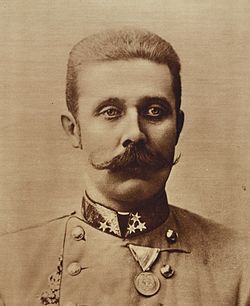
Franz Ferdinand: eldest son of Carl Ludwig, the brother of Emperor Franz Josef, was born in 1863. Educated by private tutors, he joined the Austro-Hungarian army in 1883. His military career included service with an infantry regiment in Prague and with the hussars in Hungary. While in the army Ferdinand received several promotions, captain, major colonel, and general.Later Franz Ferdinand is shot to death along with his wife by a Serbian nationalist in Sarajevo, Bosnia, on this day in 1914.
Subscribe to:
Posts (Atom)